Click to invest now


Investing in real estate offers many paths, but two popular ones are Fix-and-Flip and Buy-and-Hold. Each has its own set of benefits and challenges. Wondering which one suits you best? Let's break down both options to help you decide.
Think of Fix-and-Flip like a quick makeover project. You find a house that's seen better days, buy it, fix it up, and sell it for a profit. It's all about fast changes and fast cash. But, it needs a good chunk of money upfront for buying and fixing the house, and a good sense for spotting properties with potential.
Buy-and-Hold is more like a marathon. You buy a property, keep it for a while, and maybe rent it out to earn some steady cash. Over time, the hope is that the property's value goes up, and you make money both from renting it out and eventually selling it at a higher price. It's a slower process, but it can bring in a continuous stream of income.
When it comes to choosing between Fix-and-Flip and Buy-and-Hold, several factors come into play. Let's break them down:
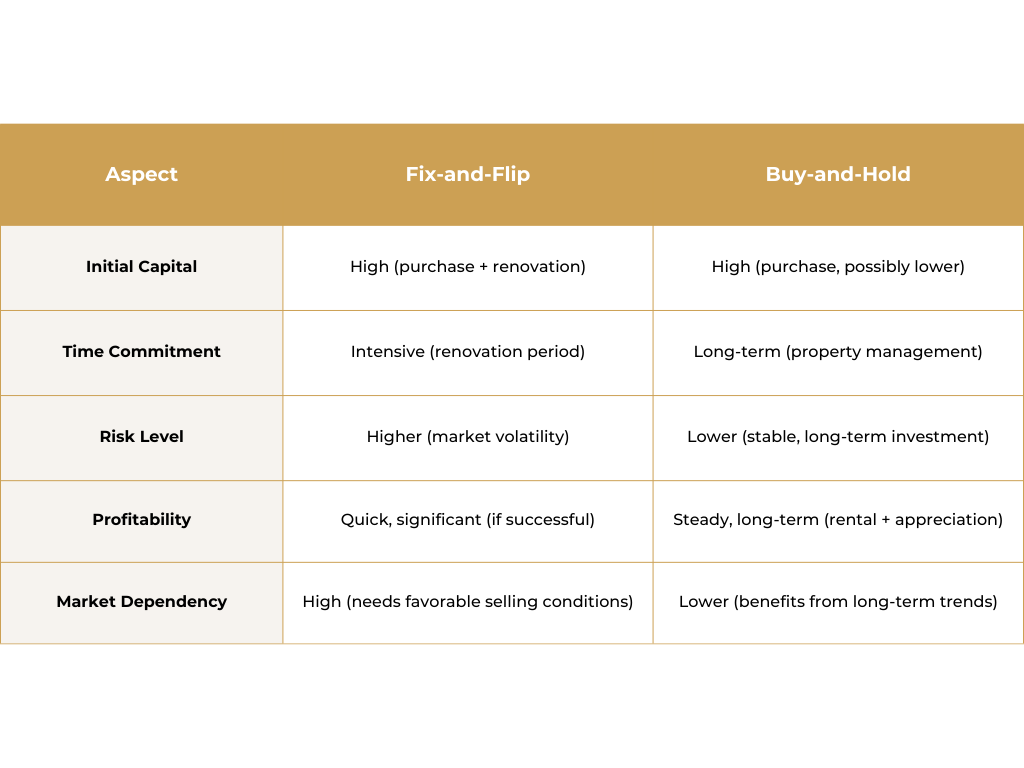
Fix-and-Flip: This strategy often requires a considerable initial investment not just to purchase the property but also to cover renovation expenses, which can sometimes be unpredictable.
Buy-and-Hold: While also requiring a significant initial outlay, the Buy-and-Hold strategy might be more flexible if the property is already in a rentable state, potentially reducing the initial cash requirement.
Fix-and-Flip: Fix-and-Flip projects can be time-consuming, with much of the effort concentrated on the renovation phase and the sales process.
Buy-and-Hold: This strategy involves a long-term commitment, dealing with tenants, and maintaining the property, although employing a property management company can alleviate some of the burdens.
Fix-and-Flip: There's a higher risk associated with market fluctuations that could affect the selling price, alongside the potential for unexpected renovation costs.
Buy-and-Hold: Generally considered a safer bet for long-term investment, this strategy provides a cushion against short-term market dips through rental income.
Fix-and-Flip: Successful flips can result in significant returns in a relatively short period, though these profits can be variable and dependent on external factors.
Buy-and-Hold: This strategy offers the potential for consistent rental income and long-term capital appreciation, contributing to a more stable financial growth.
Fix-and-Flip: The success of a flip is highly dependent on the current real estate market conditions, requiring a strategic approach to timing the sale.
Buy-and-Hold: Less sensitive to short-term market changes, this strategy benefits from the general upward trajectory of real estate values over time.
Your choice between Fix-and-Flip and Buy-and-Hold depends on what you're looking for. If you're after a quick project and quick money, and you're okay with taking a bit more risk, Fix-and-Flip might be your game. But, if you prefer a steadier, longer-term investment that brings in regular money and grows over time, Buy-and-Hold could be the way to go.
Remember, there's no one-size-fits-all in real estate. Think about what you're comfortable with, what your goals are, and maybe talk to an expert before jumping in.
Explore Opportunities with Faris Capital Partners. Are you an accredited investor looking to delve into apartment group investing in multifamily properties? Click here to arrange a discussion with our Investor Relations team and learn more.
Are you curious about what sets Faris Capital Partners apart? Download our information booklet to explore how we make it all possible and create value for our partners. Click here to access the booklet!


mj.png)
nh.png)

klo.png)
_war.png)
mkj%20(2).png)


ggj.png)

p.png)

ok.png)
-n%5D.png)